Showing posts with label Travel. Show all posts

Sunday, 31 January 2016

How to jaywalk, by an expert

Not how it's done
In 2002, tracksuits with ‘BABE’ on the butt were cool, S Club 7 were still in the charts, and the US Army raised a few eyebrows when they released a first person shooter video game as a recruitment tool.

I was never good at shooter games. I was good at that game Toad. When game consoles were the size of your face and made up of just a few pixels, the aim of this game was to get your ‘toad’ (a square) across the road by moving into spaces before the cars (rectangles) reached you. So instead of becoming a solider, I became a jaywalker.

My personality suits jaywalking – i.e. navigating the road on my terms, rather than being dictated to by crossings and lights. I am very impatient. I don’t like being told what to do. I’m decisive. I walk alone a lot. And I’m often running just behind schedule enough that waiting a whole minute at the side of an empty road will switch me from bang-on-time to actually late.

I’m not here to tell you to start jaywalking: that would be against the blogger’s code of responsibility to readers. It’s not illegal in Britain, but then neither are fireworks or teaching yourself how to do backflips on the home trampoline or piercing your own ears. But like all these things, if you have a sneaking suspicion that you might not be very good at it, you probably shouldn’t try it. And if you are going to do it, do it like a boss.

Family members, fiancĂ© and future medical insurers: stop reading now. For everyone else, here’s how to jaywalk.

Be gazelle
You may be a sloth in your resting life, but when you are crossing the road, you are a gazelle. Think gazelle. Be gazelle.
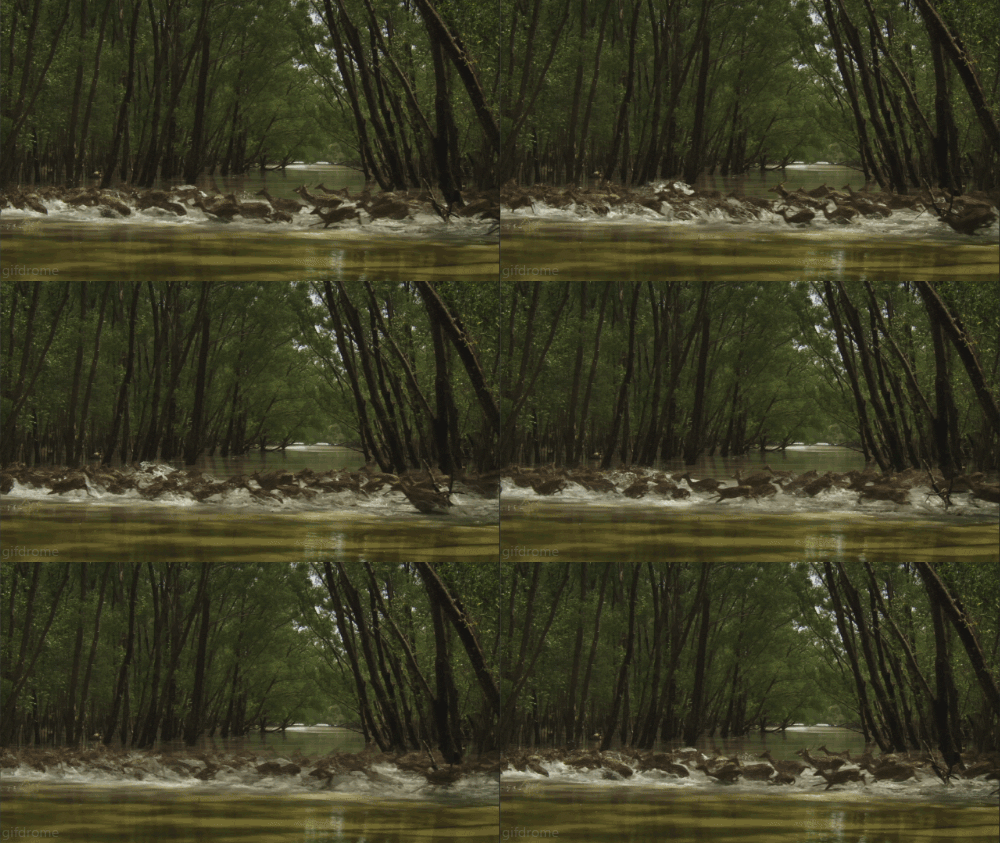

Gazelles know that crossing a road is not the time to check your phone/stare at the sky/tie your shoelace/read just one more page of your book. Have you ever seen a gazelle pausing to check Google maps while it’s springing across the savanna?

You need to be focussed on moving across that treacherous river without being snapped up by a crocodile. By which I mean getting over the road without being knocked down by a lunatic on a Deliveroo bike. Save the cat video for your lunchbreak, or wait for the green man.

Always check the side roads
Side road traffic is like love and periods and cravings for new potatoes: it appears when you least expect it, with potentially dramatic results. Even if you’ve walked across the same road every day, always check there is nothing coming. One day there will be and it won’t hit you because you remembered this rule, and you will feel a weird sense of pride, relief and invincibility.

Be decisive
You’ve done the necessary calculations and decided you can make it. Go now: another half a second and the car crawling along 10 metres away has found the accelerator and you have to re-evaluate the whole thing.

Never follow a stranger over the road
Like the adult version of stranger danger. Even if they look like they have this jaywalking thing down to an art (and it is an art, darling), don’t follow them. They could be high or unfamiliar with the concept of cars or just an idiot. Plus they’re only looking out for themselves – you follow them two seconds later and the situation has changed. You are the master of your own fate. Yes, you. Not that guy strolling confidently in front of the No. 76 without a care in the world.

Drivers have feelings too
Yes, the rumours are true: drivers are actually human and they need to get somewhere as well. Take advantage of a momentarily clear road and sloooow vehicles, but don’t walk out when they’re accelerating towards a green light and expect them to stop. And save ‘Hey, I’m walking here!’ for moments of justified outrage.

Learn to read traffic
With focus, study and practice you can become a Jedi of the road. Or a Sith, if that’s what you’re into. That driver isn’t indicating, but have all the other cars ahead of them turned towards you? Which way are they spinning the wheel? How long does it take for the lights to go green after the red man has appeared? It becomes a big puzzle you get to piece together.

Crossings are a conspiracy
I’m going to destroy everything you believed about society, the nature of the universe and the order of life. Don’t bother pressing the button at most pedestrian crossings. Like the ‘close doors’ button in lifts, most are put there just to make us feel like we have some control over our lives. Don’t buy into the lie. Truth is beauty. Ugly, sad, twisted beauty. Instead, find the nearest CCTV camera and stare accusingly.

Buses are slow
Although the phrase ‘What happens if you get hit by a bus tomorrow?’ is often used to force people to consider their own mortality, they are far from the being the scariest vehicles on the road. They're like Great White sharks: they're big and tough up close, but this hyperawareness also means you’re more likely to avoid them. Of course you should still look out for them, but it's hard to overlook something bright red that accelerates at the speed of a morbidly obese walrus and stops every 100 metres.

Beware professional drivers
Taxi and van drivers’ livelihoods depend on getting through traffic. They therefore have no tolerance for anyone else being on the road. It can appear that they are playing a game of human bowling, in which you are the pins. Some will accelerate straight at you. They are most likely to beep and shout wildly unimaginative swear words. Treat them with the caution you would grant to a rabid dog on speed who has spotted you wearing Lady Gaga’s meat dress.

Think bike
If you’re crossing between cars stuck bonnet to trunk in a traffic jam, always, always, check that there’s not a Lycra-clad speed demon weaving through the middle or up the side.

Cycling in London is scary, which means that some cyclists see themselves as gladiators pitched against everyone else on the road. They will not deign to inform us which way they plan to veer off to next. Red lights and one way streets and laws about riding on the pavement do not apply to them.

To avoid getting a spoke through your leg, listen out for the sinister sound of spinning wheels and for the bells they're constantly hammering away at, in the manner of a crazed priest announcing a coronation or a wedding. And stay as far away from anyone on a Boris bike as you can without actually leaving the city.

And motorbike
Motorcyclists are more vigilant but also more dangerous if you’re a pedestrian. Not only are many willing to weave into any space they can get into, regardless of who’s currently filling it, but they have the acceleration to change a road crossing situation before you can say Hell’s Angels.

Choose life
The aim of the game is to get across in one piece, which means waiting for the right time, even if that takes swallowing your pride and letting the red traffic light usher you across. You won’t reach your destination feeling like you beat the man and the tourists and the whole damn system, but you will get there, which is more important. Apparently.

Saturday, 9 January 2016

Love and sorry and old bananas: 25 things I've learned by 25

Let’s be clear: this list is not the sum total of my knowledge of the world. For starters, I have learned more than one thing a year, and there’s nothing from 16 years of academic education on here. But just for fun, here are some basic truths and not so simple lessons from 25 years as me.

1. Don’t apologise when you don’t need to
As a British woman I got served with a double dose of ‘Please let me apologise profusely for things that aren’t my fault.’ Apologetic words that enable this condition include the obvious ‘sorry,’ plus ‘just’ and ‘only’. Yes, you absolutely need to say sorry when you’ve screwed up, even if you’re terrified that the other person won’t forgive you. But don’t apologise for your existence or for doing your best. Treat these words like morphine: use sparingly so their impact is really felt when it’s needed.

2. Put Vaseline on your heels to stop your shoes rubbing
You’re welcome, poor little ankles. Also, if you’re too lazy to properly remove all your eye makeup before you go to sleep (bonus life lesson: always remove your eye makeup before you go to sleep) you can put just a little bit of Vaseline on your eyelashes and you’ll wake up without that ridiculous black gunk in your eyes.

3. Falling in love is like waking up with superpowers
Suddenly there’s a force within you that makes you want to do things that previously would seem impossible and mad (like scale tall buildings and shoot webs out your wrists and get married). It’s fun and scary and inspiring so make sure you use it to do something good.


4. Being in love requires effort
It’s answering their texts and being somewhere at the time you say you’ll be there, and calmly talking about how you feel when they’re pissing you off so you can work it out, and not holding a grudge. Which all sounds like a ridiculous amount of unpaid labour to the merrily single. The magic trick love performs is that you’re transformed into someone willing to do all that plus unload the dishwasher and overlook the fact they like Top Gear in exchange for the chance to have them around.

5. You can go against people you like
Peers, parents and friends will have expectations for your life, from what you wear to where you work to how often you go out and get hammered to your reproductive adventures. Understand that deciding to go against them might well cause fallout, but you don’t have to live out the narrative someone else has written for you.

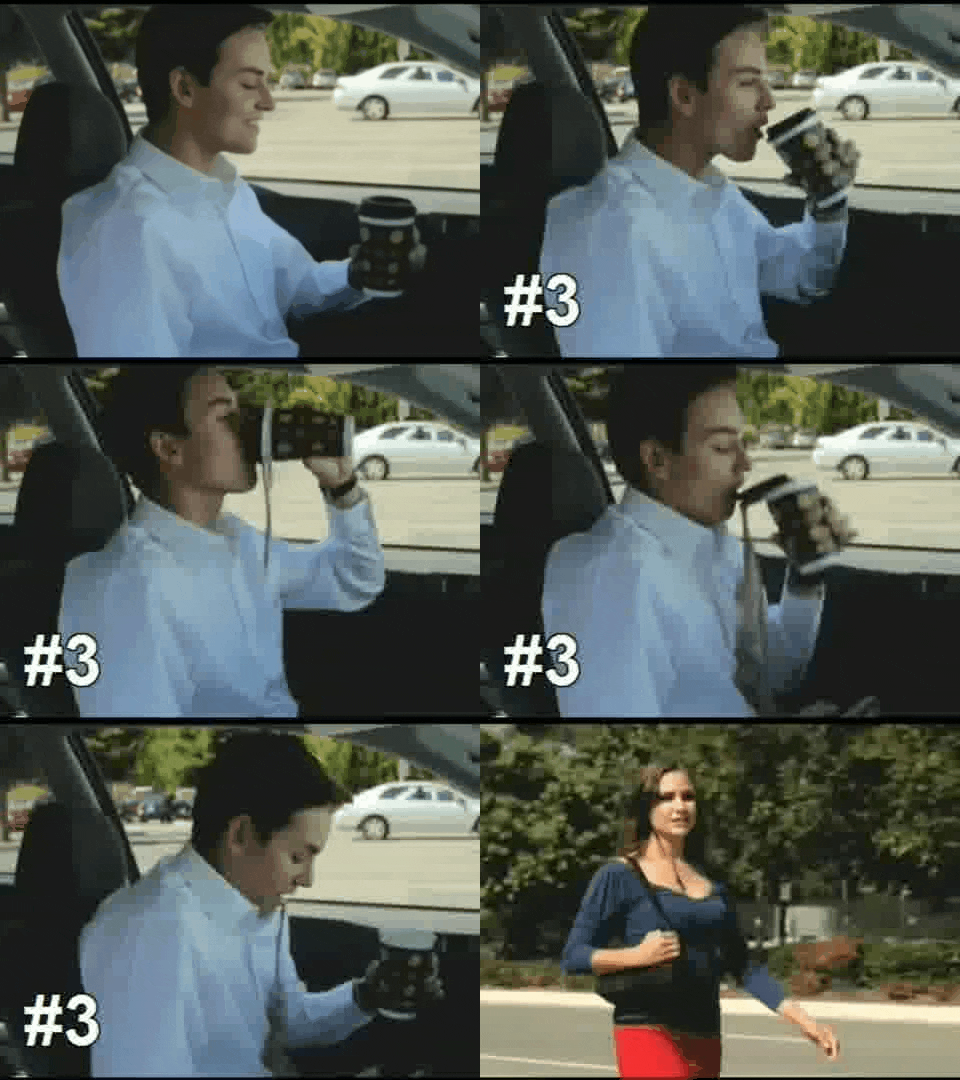
6. There’s a right way to carry takeaway coffee cups
With the hole you drink out of facing away from you. It’s a law of nature that coffee is drawn to clothes, especially if you’re wearing something white, new and/or expensive. Which is why they never serve coffee in takeaway cups at weddings.
  

7. Courage doesn’t mean never being scared
To paraphrase Mufasa. It means being able to admit fear and go crashing on with it anyway. Go on that rollercoaster, get that tattoo, watch that movie that had the world’s toughest critic sleeping with the light on for three months. Take the job with the paycut because it’s your dream, ask out that person you’ve been gazing at longingly for two years, seven months, three days and about an hour and thirty minutes. Not everyone is a firefighter running into a burning building but we all have to be brave in tiny and massive ways.

8. Drink lemonade when you have a sore throat
Let it go flat and chug it straight from the bottle. No one will ever believe it works, but as long as you no longer sound like Darth Vader after he’s had a long night of karaoke and cigarettes, who cares?

9. Never brush curly hair
Ignore the books, movies and adverts that show someone brushing out spiralling ringlets. In reality, you will end up looking like Hermione circa The Philosopher’s Stone. It wasn’t magic that fixed her hair for the Yule Ball: it was realising that you should replace that toothy devil device with detangling fingers, good conditioner and a reliable finishing product.


10. Dare to say hi to new people
Yes, chatty strangers can be annoying when you’re tired and you just want to buy oranges without a lengthy discussion about someone’s cat. But sometimes it’s worth plunging into conversation with a total stranger. Sure, they could be dull or racist or creepy but you could also just have a fun one-time chat with an interesting person, or you could even make an awesome friend. Give people a chance and they might surprise you. Yes, that includes Chelsea fans.

11. You don’t have to understand art to enjoy it
You don’t have to know much or even anything about art, as long as you approach it with an open mind. The more you see, the more you’ll know what you like so you can hunt out relevant exhibitions and get stuck into the bits that really grab you. At the very least you’re getting the chance to see how someone else experiences the world, which is fascinating.

12. Always have a pen
At least one. If you think you already have one, pack another one. Just like London taxis, they have a tendency to disappear right when you need them.

13. Always have tampons
It may count as a luxury, but it’s one you don’t want to be caught without.

14. Be kind in love
You can’t love everyone who loves you, and not everyone you want will want you. But be gracious. Treat people’s hearts like fluffy little guinea pigs that need to be handled delicately, even when you know they can’t really belong to you. And not like footballs designed to be kicked off down the field and slammed into the mud without a second thought.

15. Sex is not like it is in the movies
The camera doesn’t cut slowly away to the window when you’ve removed enough clothes to upset the censors. Seductive music doesn’t start automatically playing in the background. And post-sex hair definitely doesn’t look so rakishly attractive in real life. Instead, it’s a lot of fumbling, sweating, grunting and unexpected noises. It’s less dignified, a lot messier and much more fun.

16. Women don’t have to wait for someone else to make a move
Disney and Jane Austen and movies set in high schools have got a lot of people thinking that in heterosexual relationships, the man is the one who initiates any romantic possibilities. He asks her out, he picks her up, he pays. Not having the patience for this nonsense doesn’t make you needy or bossy or unfeminine (which aren’t always bad things btw). You wouldn’t go to a restaurant and wait until someone brings you the food you want: the only way to make sure you get the dish that’s caught your eye is to go up, politely place your order and see if it’s available.

17. Frozen banana tastes like ice cream
Get an old banana. Mush it up. Freeze it. Take it out. Eat it with peanut butter and/or chocolate chips. Feel smug.

18. Embarrassing moments are just future funny stories
You can speed the process up by trying to see the comical side at the time. That said, it’s also perfectly acceptable to save the ones with no witnesses for yourself.

19. You don’t have to drink alcohol
Benefits include not knowing what a hangover is, always being able to remember where you put your phone and having more money for books, clothes and obscure kitchen gadgets. Unfortunately, you do have to realise that some people will have a problem with this, even though you couldn’t care less what they do with their bodies. This might mean that you miss out on some awesome friendships but that’s their fault, not yours. Those who matter don’t mind, those who mind should really reassess why it is they take issue with your life decisions.

20. If you microwave a marshmallow it grows huge
I learned this from Dawn in Buffy. It’s about the only scene from the show you can safely re-enact in your own kitchen.

21. Make sure you know how to be awesome on your own
You are the only person who is always with you so you should probably learn how to get along with that little voice in your head. That includes in your own home and in the world spreading out beyond that square of window. Enjoy the voice's creativity and sense of humour. Find out what it likes (rom coms, photography exhibitions and indie pop rock). Teach it to map read, tell it off when it’s being mean, read it books and teach it new things just for fun.

22. An oven thermometer will change your baking life
If your cakes usually end up as a flat mess that looks more like a pancake that’s been run over by a lorry than the photo in the book, you need one of these. Hang it inside your oven somewhere you can read the dial and you’ll know that whatever else you’ve screwed up, at least the temperature is spot on.


23. Carry an umbrella
London weather is created by a control panel in the sky that’s operated by a drunk guy randomly fiddling with dials, pressing buttons and spilling coffee (see life lesson 6, dude). To combat this madness, get a mini umbrella and put it in your bag, next to your keys, pens and tampons. Much better than a soggy copy of the Metro or a Tesco bag.

24. No one knows what they're doing all the time
A constant stream of holiday photos, statuses about amazing parties and excited job/relationship updates has convinced us all at some point that the world is at a big carnival we’re not invited to. However, it’s also true that the more ‘grown ups’ you meet, the more you realise that no one has every aspect of their life or personality totally sorted out. Some people are better at hiding the not-so-shiny bits than others (money really helps with this) but ultimately we’re all wondering if we’ve made the best life decisions and what’s coming up next and if we can handle it.

25. Always dance
Don't condemn yourself to the sidelines. Shake it while you've got it and regret nothing. Dignity is less important than feeling like BeyoncĂ© on the dancefloor for a night. 


Sunday, 3 May 2015

Five things I learned from travelling alone

Amsterdam... somewhere
Some people can’t even imagine drinking a coffee on their own, while others will eagerly send themselves to the other side of the world, phone off and backpack in hand. Going it alone isn’t for everyone, but there are definite benefits to taking the plunge and travelling solo. Determined to give my passport some use but without the patience to begin a lengthy dialogue about where to go, I said goodbye to London and Guten Tag to Berlin, hallo to Amsterdam and salut to Paris on my own. My language skills didn't take off much beyond this, but I did learn some other things along the way.  

Appreciate the brilliance of being alone
As David Foster Wallace rather gloomily pointed out, we are all of us marooned in our own skulls - we are all ultimately alone. We can either drive ourselves mad constantly scanning the horizon for the glimpse of another ship, or we can roll up our sleeves, hunt out a reliable water source, and get on with it Swiss Family Robinson-style. When you travel solo, chances are you will be on your own for at least some time, whether that’s on the flight over, for a long train journey, or even just lunch. This is actually quite fun. No, seriously.

Having no one else to worry about means you can do whatever you want without worrying about seeming rude or inattentive. Want to stare out the window aimlessly for four hours? Or listen to a podcast without seeming antisocial? Or just catch some sleep? No one can distract you or complain. Or post photos of you mid-nap on social media.

I think many struggle more with this around meals, but eating alone can also be something of a relief. Not only can you use a fork instead of chopsticks without judgement, but there’s no one to argue with over where you eat, no small talk, and all the time in the world to people-watch, eavesdrop on conversations (like eating off the floor, we’ve all done it, so don’t get high and mighty) or just to read. I’m not saying we should all seal ourselves up inside one-person-only cells for the rest of our lives, but learning how to spend a few hours or days on your own is good brain training.

You will meet awesome people
Getting out of your comfort zone gives you the chance to meet people you would otherwise never have crossed paths with. Whether it’s for a dinner, a day, a weekend or the rest of your life, taking the opportunity to get to know someone else's point of view can only teach you more about what's outside your own little bubble. Not everyone you meet will be your new best friend, and you're lucky if you find someone like that, but it's still worth talking to them.

However, the caveat is that to find these fantastic fellow wanderers, you also have to put the effort in. Luckily, it’s easier to be brave when you’re in a place where no one knows you, plus being deprived of conversation will make you more keen to take a chance when the opportunity arises. Strike up a chat with the person on the plane, say hi to that person in the park who caught your eye. You never know, it could be the start of an interesting discussion or a beautiful friendship (or just really fun). 

More practically, you also have to put yourself in social situations, which probably means hostels. Do your research before you go, and make sure other solo travellers have ticked yours off as a good place to meet like-minded people, rather than couples and groups of friends who are more likely to stick in their own little circle. No one is saying that sharing a room with 10 strangers and all their various smells, snores and nocturnal activities is glamorous. However, in between cursing the guy two bunks over for his persistent tractor imitation, and silently begging the couple in the next bed to just hold off for one night (both true stories), this is the place to meet people. Finding a hostel with a bar and/or communal area is another good tactic. Even if you don’t drink, this is a great place to meet people open to making new friends. This works even better if some big sporting event is on. Who cares if no one there has anyone competing in the curling: pick a side, place a bet, and get ready to cheer.

You can go wherever you want
Forget being dragged shopping for four hours, or to the Chair Museum, or to slowly roast on a beach in the sun all day. You’re the boss and you set your own itinerary. You can be selfish and not have to waste your time doing things others in a group might love but which bore you to tears. Want to go to another museum? Go ahead. Feel like a long wander through the city? Sure. This can actually be a bit scary, as it means that if you don’t take responsibility for filling your days, you won’t actually do anything. Get some guide books and a map before you go, and highlight the stuff you want to see, then work out a sensible way to get round it. You can do this on the plane, if you focus (not that anyone would leave it that late). Even if you don’t see it all, this will make sure you get to the crucial bits. You can also book tours and activities once you’re there, to make sure you drag yourself out of bed and at least do something vaguely holiday-like.

Arriving is the worst
No matter how excited and prepared you are, it’s normal to experience a feeling of being completely overwhelmed by everything around you when you first arrive, as well as by everyone else seemingly knowing where they’re going. Knowing that this ‘small fish in a big sea’ feeling is coming should make it easier to handle. It might be tempting to hide in a corner and rock on your knees while wondering when the next flight home is or testing out the 'No place like home' heel clicks, but you’ll feel much better if you force yourself to get out and do something in your new environment. It will go away, so don’t worry about it: just focus on your day.

You will get lost and it will be fine
I spent much of my time alone in varying degrees of being lost. These range from, ‘I know I just have to go left down this street somewhere,’ to ‘I’m sure I’ve walked past this desolate Soviet-era building/quaint bakery/sex shop at least twice already,’ to ‘It’s getting dark, I’m not even on this map, and I’m pretty sure those are vultures.’ 

As I've recorded on this blog several times before, I can’t read maps, so if you also suffer from this, a bonus tip is to learn how to read maps before you go. Also, always read the full name of the street, as it turns out that evil city planners really like to give very close roads similar names. And map-illiterate people like to totally ignore them when they do. If you plan nothing else, make sure you know where your hostel is from the station or airport. In my experience, locals know when you’re lost, and they will try and help you – at least they will if you’re a 23-year-old woman.

There’s also something to be said for smartphones. Everyone is glued to these anyway, and since I didn’t use one, every time I pulled out the last remaining paper map of Amsterdam in existence (which was, on average, every two minutes and eighteen seconds), everyone around me could see I was a gullible tourist with no idea where I was. Everyone except for the couple who asked me for directions, despite the loud and proud ‘I <3 Amsterdam’ t-shirt. (Oddly I actually knew where I was at that moment; is this what you people feel like all the time?) 

Luckily, getting lost can actually lead you to places you wouldn’t otherwise have found, like the art studio in Paris run by a charming and talented guy from Portland delightfully named Buzz, and the colourful neighbourhood in Berlin dotted with the types of gypsy caravans Enid Blyton wrote about, as well as bits of the Wall. That said, the relief at getting back home and knowing where you’re going without having to pull out a map every two seconds makes you want to run down the well-known street, tearing that frustrating bit of paper into confetti and screaming 'I'M HOME AND I KNOW WHERE I AM!' Until you take a wrong turn.


Saturday, 27 April 2013

The Queue-rious Nature of Queues

'I don't care if we're eighty years early, we are getting those
One Direction tickets!'
There has been a vicious rumour circulating about us Brits that needs correcting right now. No, I am not talking about the bad teeth, bumbling speech or general propensity to be evil attributed to us by American TV. Let’s get one thing straight: Britons do not like queuing.

No sane person likes queuing. Whether it’s in a shop, on the road or at a theme park, queues, like rain and taxes, are perceived by Brits as an inevitable part of life, but not as a joy. It is probably this acceptance that makes others think we enjoy waiting in line. While people from other countries might refuse to adhere to such a system, we are willing to go along with it, we’ll just grumble and moan in the process.

If we're not careful, queues can becomes unpleasant reflections of one’s life, as the unending state of limbo stretches into a metaphor for existence. Neither in one place or the next, stuck waiting to fulfill our true purpose, we watch the people around us also striving for the same goal, reaching it before us or following in our footsteps, everyone silently agreeing to conform to this system that takes a chunk of our life in exchange for achieving a particular end.

Once you have entered The Queue, your concept of time changes. Restricted by your status as part of The Queue, you are no longer free to choose what to do with your time. You forget what it was like to not be in this queue, and you suddenly find yourself unable to imagine that a time exists beyond it, that one day you will not be standing here, waiting for that person to count out every single penny in circulation, or for the engineer to fix the rollercoaster. For the first time, you are forced to obey Yoda and countless self-help gurus, and to live in the moment. Unfortunately, the moment you are trapped in is one of frustration, doubt and boredom.

The Queue also screws with your concept of space. You may well have walked through or past the place where you are now queuing countless times, unheeded by the system you have suddenly signed on to, able to stroll nonchalantly about in a wild and innocent fashion. You may even have skipped a little. Now, however, you are blocked in, unable to move too far to either side for fear of losing your place and forfeiting your contract, while a few measly steps forward are now perceived as a victory. You look back wistfully on those blissful times of meandering lazily along, unstructured and unbound, and wonder how you could have taken that freedom to stride so boldly for granted.

At this point, you begin to make bargains. You will never take your spare time for granted again. You will spend every minute doing useful, important, adrenalin-pumping activities and carpeing the diem.  You will learn a language, go skydiving, hug a tree – all the things that you thought you would have time to do but never did, because before The Queue there was always the future. You will never neglect the freedom to move around at will again. You will roam freely about the earth, noting every individual step as a sign that you have the agency to control your own path, and the chance to follow it. Once The Queue has freed you, you will grab life with both hands and never spend another minute in such a limp, helpless state.

And then the customer before you takes their bags, the car ahead moves off, the theme park worker ushers you on to the rollercoaster, and all those lessons, all those promises, vanish into thin air. You have made it. You have completed your contract with the queue, sacrificed minutes or hours of your life and promised to be there, in that place rather than anywhere else, and you have been duly rewarded. Life goes on, The Queue is forgotten, and you forget what it was to be so restricted, and return to your routine.

Friday, 21 September 2012

A Postcard Post

"I know there's a desk under here somewhere..."

Along with blurry photos, souvenir t-shirts and the sudden need for sunglasses, postcards are a sure sign that you are On Holiday. Whether depicting white sandy beaches at sunset or something involving a dirty pun, they are a way of telling family and friends exactly what you are up to while they are stuck at home.

There is something rather delightful about receiving a postcard from half way around the world (or even just Kent.) Postcards make you feel that despite a hectic schedule of camel racing, scuba diving and cheese rolling, your friend thinks enough of you to take the time to purchase a postcard, track down a suitably expensive stamp and hunt out a post box. Once they have popped through the letterbox and been suitably exclaimed over, postcards go on to take pride of place on a fridge or corkboard, or maybe on the Random Stuff Pile on the side. Once here, they become part of the furniture, remembered only when you are looking for that bank statement, pizza voucher or event poster.

There is always the slight chance that of the myriad of cards that you send, a few won’t make it. This can be particularly awkward if they are aware that others have received one. My dad claims that he sent my brother, sister and I one each from South Africa, yet while Claire’s and mine arrived shortly after him, Matt’s has apparently been lost in the mysterious swirling fog that is the worldwide postal service.

Given the unreliable nature of the post compared with instant forms of communication now available to us, it often seems like postcards are more effort than they’re worth. I generally buy postcards with the vague notion of perhaps sending them at some point, only to find them a year later, still in their little paper bag with a Eurocent coin and flimsy receipt floating around in the bottom. However, before undertaking the Mad European Dash, I made a solemn promise to myself that I would send postcards this year. In the light of this decision, we dutifully went through the rigmarole of buying, stamping and sending the postcards from a variety of beautiful, historical and generally postcard-worthy locations.

Was it worth it? In time-honoured tradition, we are currently waiting for the postcards to arrive after us. While three have made reached their respective fridge doors, five are still missing in action. This includes Matt’s, who seems to have fallen out of favour with the god of postcards. It certainly felt good to take a minute and think of home while standing in the middle of the fearsomely beautiful Vienna or a cold and windy Brussels street. While the simple messages I managed to fit on could easily have been conveyed quickly and overall more cheaply via text, the little moment of delighted surprise was worth the extra effort.

Thursday, 20 September 2012

Lessons learned on a mad dash round Europe

No matter what angle he tried, she kept sticking her head in the way.
Along with various facts about Amsterdam canals and a profound understanding of the habits of the Austrian monarchy, my six days, six nights, six countries and approximately nineteen train journeys have taught me some invaluable lessons about how to travel.

Learn to pack light. Of course you intend to wear all four pairs of shoes, use every millilitre of conditioner and read all seven books when you are cavalierly throwing them into your suitcase. However, when you are standing forlornly at the bottom of the fifth flight of stairs you've come across in one Metro station, chances are that you would happily exchange Life of Pi or the red trainers that match the cardigan for the extra boost. Besides, when you’re collapsing into a train seat after a hard day of trekking through palaces and scoffing pastries, an iPod and magazine are more than sufficient entertainment.

Motorists in Europe will try to kill you. Be aware that motorists in Europe see pedestrians as sport rather than obstacles to be avoided. The friendly green man on the pelican crossing is not so much a signal that you may cross the road without danger of death as a challenge to try and do so. The traffic lights may officially be red, but be prepared for trams, motorcyclists and BMWs to hurl themselves at you without remorse. Indeed, every road crossing becomes somewhat reminiscent of that old game, in which you are frog trying to make it across the road without being squished. After employing many strategies, I discovered that the safest approach is to form a large group on either side of the road and cross together. While this may seem like a rather touching act of mutually beneficial camaraderie, it’s not: the aim is to make sure that you are in the middle with everyone else acting as a buffer between you and certain death at the hands of a malicious French driver.

No matter how high your grade, GCSE German will not help you. While certain phrases may have been useful when crafting that coursework or desperately trying to understand what the distant voices on the tapes were saying, in the real world no one cares that ‘Ich gehe gern ins Kino’ or that ‘je m’entend bien avec ma famille’. Confronted with a sign that doubtless conveys some vitally important information, the knowledge that ‘Ich habe eine Schwester’ suddenly seems deeply unhelpful. Furthermore, when you do work up the courage to respond in the native tongue (or a variation thereupon), the other party will inevitably respond in perfect English, which may even extend to sarcasm. Either book yourself into that foreign language course now, or avoid further humiliation by admitting defeat, tearing up the phrase book and going to America.

It is possible to execute a night-to-day look in a train toilet. Night trains may be a useful way of covering long distances, but they are not exactly conducive to stylish dressing, personal hygiene or daily skin routines. While the train company proudly advertises the onboard washroom, this turned out to be neither a room nor somewhere it is possible to wash more than a finger, owing to the fact it is actually an upright coffin with a sink thrown in. However, with a careful combination of wriggling, balance and grim determination, it is possible to enter as a pyjama-clad, make up-free, tired and dishevelled mess, and emerge a jean-clad, made-up, tired and dishevelled mess. Make sure you take baby wipes to replace your shower, a steady hand for the mascara and leave your best, carpet-scraping pyjamas at home. And if all else fails, throw on the dark glasses, grit your teeth and think about the croissant calling your name from the next exotic location.

Map reading is a crucial life skill. Consider the following exchange:

“We need to go down this street, through the park, along the canal and turn left.”
“No, it’s straight ahead, second left, first right, over the bridge and then third left.”
“That’s what you said yesterday, and we ended up in Calais.”
“Actually that was Hamburg.”

If you have ever found yourself in an unfamiliar location with a friend/relative/significant other, chances are you have had a variant of this conversation. It turns out that along with percentages and the names of the Tudor monarchs, map-reading is actually useful in real life as well as in school. At some point in your travels you will be lost. It may be that you are standing at the statue of an entirely different King Maximilian, are in the wrong city, or are desperately trying to find your Amsterdam hotel in the rain as it gets increasingly cold and dark. At this point, the ability to read a map correctly, preferably the first time, will seem very important. Fortunately, many big cities have large maps at various points in the city. While standing in front of these arguing may reveal you both as embarrassing tourists, if it means saving you a sprint to the station or a wrong turn down an alleyway, it’s worth losing the je ne sais quoi and finding that ‘You are here’.

These are not necessarily the most important lessons I learned on my travels. As you may have noted, there is no mention of how to securely attach your passport to an unused part of your leg, how to operate those foreboding lockers in train stations, or even details about the military planning required to send a postcard back to England. However, should you ever find yourself planning your own mad dash around Europe, I hope that these brief lessons will help you avoid discomfort, danger and deep humiliation.

Feel free to share any travel tips, tales or terribly unnerving warnings of your own below.