Monday, 28 March 2016

What does Queen Victoria's sex life have to do with anaesthesia?


Pop culture has created an image of Queen Victoria as a sour-faced, prudish old widow in a massive black frock with a sagging frown. And also, more obscurely, as a werewolf. She was definitely fiery, brutal and ready with the cut-downs in the masses of letters and diaries she wrote throughout her long life, but she wasn't always a grumpy hag.

She had a dirty sense of humour and a quick wit, and loved sex and laughing at silly things. She was barely 18 when she became Queen in 1837, and her advisors tried to discourage her light-hearted interests out of fear that the public wouldn’t take her seriously. She was stubborn, playful and youthful, and these traits ensured that she was open to new ideas that were exploding around her in science and art - an interest encouraged by her husband Prince Albert.

A brief history of anaesthesia that won't send you to sleep
Early medical experts had two responses to basically any illness presented to them: draining blood or amputation. It’s not surprising, therefore, that they’d long been after a way to relieve a patient’s pain while they operated.

Unfortunately they didn’t yet appreciate the astounding facts being uncovered by clever science brains as anything more than amusing reads. Scientists had been mucking around with different chemicals that worked as anaesthetics – as well as other things – for hundreds of years, because that’s their job.

Laughing gas


For example, in 1772 Joseph Priestley discovered nitrous oxide, which lead seven years later to fellow scientist Humphry Davy apparently having tremendous fun trying it out on himself and animals, eventually noting that it could be used therapeutically.

(Scientists having tremendous fun or dying while trying out new things is a bit of a theme in history.) However, it was mostly used in comedy shows, including one launched by a man who named himself ‘Professor’ Samuel Colt, who used his show to raise money to build the prototype of a revolver...

Think about it as we see weed today. At the moment, it’s mostly a recreational drug to get you high, but it does have medicinal properties. Similarly, no one was interested in this party trick's potential for medical use until a man/dentist named Horace Wells attended one of these laughing shows in 1844.

Wells realised, as Davy had, that nitrous oxide could be an anaesthetic. He found this out in the only sensible way: he had the travelling circus performer administer it to him, realised he felt nothing, and then a few months later got his colleague Dr Riggs to remove his tooth while he was under its influence. Unfortunately for Wells, when he tried to demonstrate it on someone else, the patient cried out in pain and everyone jeered loudly and obnoxiously.

Ether is a gas
A few years before Wells saw more than the funny side of nitrous oxide, scientists were getting interested in ether. Again, they had been aware of how to produce this for a couple of hundred years, but it was a laughing stock among the public. Fortunately, doctors started trying it out and found that - phew - it worked.

The first public demonstration was in Massachusetts General Hospital, where John Collins Warren was scheduled to remove a tumour from a man's jaw. Apparently the man in charge of the ether, William Morton, showed up late but just in time to give the patient a 3 minute dose of ether gas that meant he didn't feel a thing.

From then on, Boston surgeons were all over the ether, willing to try it in other operations as it proved successful at keeping the patient sedated and therefore less likely to panic and end up dead. All of this dabbling with different methods and sharing of ideas means there’s still a massive debate over who anaesthetised who first and how well and who deserves the credit.

Back in Britain
In any case, the first public demonstration of ether as an anaesthetic in the UK was carried out on 19 December 1846 by dentist James Robinson in London. It does seem that some dentists are out to prevent pain. After this was deemed a success, diagnostic whiz-kid Dr John Snow worked out the best way to administer ether so that it wouldn’t kill the patients.

Dr John Snow is a bit of a hero


Not played by Kit Harington
John Snow is one of those people whose contributions to science have completely changed the world but no one has really heard of him, unless you’re talking about the guy in Game of Thrones, or you happen to work and/or drink on London’s Broadwick Street. One of his major contributions was proving that cholera is not airborne and found in bad smells, as everyone believed in the 1800s, but is transmitted by consuming germs transported in water. Sadly it took four outbreaks for the government to believe him.

Snow's main areas of interest were respiration and asphyxia, and the effect gases could have on people, especially in midwifery. After Robinson’s demonstration and his own previous dabbling, Snow developed an inhaler that would administer ether carefully. Like, not lethally. Unlike the Americans, Snow never tried to patent any of the equipment he built, and actually made sure each had clear instructions so anyone could copy it. He was also working with chloroform, which had been introduced to the UK in 1947 by Scottish obstetrician James Young Simpson.

At this point, 34-year-old Snow was the go-to anaesthesia man for London surgeons - a nice step up for a young physician. The non-scientific public was aware of this magical new invention, thanks to both science journals and humorous publications like Punch magazine, including Queen Victoria and Prince Albert.

Queen Victoria's kids

That's a lot of labour
Throughout her life, Victoria had enough children to make up a baseball team (that’s 9 btw) but she actually hated being pregnant and although she loved her children, she wasn’t super maternal. She extended her honest evaluations to them, once describing her five-year-old son as having 'a most strange face', and they were terrified of her temper like everyone else.

Let's keep in mind where she came from: she was an only child brought up by a mother who was more interested in wresting her daughter’s regal powers off her with the help of her manipulative boyfriend than in reading her bedtime stories and playing Barbie.

However, Victoria did like sex. She wrote lots of letters about what she and Albert got up to, including to her Prime Minister, and even got her husband to put a lock on his bedroom door so that all those children weren't eternally interrupting them in the act.

For the first five years of their marriage she was only not pregnant or recovering from labour for 16 months. In 1848 she was pregnant for the sixth time. Prince Albert was a science nerd and had read up about anaesthesia, so he approached her personal physicians about the possibility of using this new-fangled stuff to help his wife during the delivery.

Unfortunately, since it was still so new, they were a bit uneasy about administering it, especially since the only women who had used it so far were not royals, and a girl called Hannah Greener had recently died from the effects of chloroform during surgery. It also didn’t help that a lot of the clergy were against using pain relief in labour, believing women were meant to suffer through it as part of some divine plan. Of course, they were all men.

Drugging the Queen
So poor Victoria had to go through two more births before chloroform’s reputation had improved to the point that it was considered safe and appropriate. It helped that Simpson was a pretty big deal in the medical profession, and Prince Albert had started advocating for chloroform as President of the Royal College of Chemistry. Dr John Snow was called to the birth of her eighth child Leopold on 7 April 1853 to administer chloroform, which must have been a fairly terrifying job. He decided not to use his mask device but a drip and a bit of cloth. Going back to basics seems strange, but in the same way that some people prefer driving a manual car to an automatic, it probably required more work but made you feel like you had more control over the system.

Luckily it was a straightforward birth, if that's a thing, and Victoria described herself as 'satisfied', which is as much as you can hope to be when it comes to labour I suppose. Although medical journal The Lancet was critical of this decision, Victoria called Snow again to the birth of Princess Beatrice four years later.

Snow, in turn, refused to comment on his experiences with her, other than describing her as ‘a model patient’. Of course, one does not slag off the Queen if one wishes to avoid prison and/or a miserable life. One woman even tried to get him to talk by refusing to take the drug during labour until he told her what had happened at Queen Victoria's deliveries. Wily Snow said that he would tell her when she woke up and then scarpered while she was KOed.

Although we'll probably never know the gossip on Queen Victoria's experiences, her Royal stamp of approval was a big deal, and meant that other women could request chloroform in labour. Thanks Vic.

Monday, 21 March 2016

America vs. Britain by a Brit who loves the States


I’m something of an America geek. A lot of Brits below the age of 35 have a vague daydream about being Californian or living in New York, thanks to imports like Taylor Swift, Friends and M&Ms. But while most limit their interest to wearing t-shirts that say ‘BRKLYN’ or talking like they’re in The O.C., I learned all the state capitals and have a first class degree in English and American literature. I even had an America themed party. OK, I’m also just a regular geek.

Just to be clear, getting engaged to an American was not a weird extension of this. (I would not, in fact, recommend falling in love with someone who lives thousands of miles away, unless you’re a millionaire or teleporter.) However, it does mean I’ve visited the States more times than I would otherwise have cause too. I've been to Minneapolis (Minnesota), El Paso (Texas), Alamogordo (New Mexico), Las Vegas (Nevada), Chicago (Illinois) and through a bit of Wisconsin in the last year.

Despite all those hours studying and essay writing and movie watching, it wasn’t until I started going to different parts of this enormous country that I learned the true disparities between our cultures, lives, manners and languages. Here's my report from the field.

Customer service staff in the USA are ridiculously nice
In London, you are treated with a resigned politeness and disciplined if thought appropriate, like a friend’s child. In America, you are treated like the friend of a friend everyone is making an extra effort with. They do actually sometimes say, ‘Hi I’m Becky and I’ll be your server today’, possibly while holding a coffee pot. Most are warm, friendly and so helpful it would be suspicious if it didn’t make you want to hug them and set up permanent residence at the booth. (Just kidding, Immigration.)

The food is limited only by imagination
Americans are very much into self-determination – the right of the individual – and this extends to food. While we’re worrying about getting our five-a-day, this belief that you should be able to have whatever you want without some nosy government or First Lady wagging a finger at you means that American food outlets focus on taste and sheer delight over silly things like health and cholesterol.

Sweet, sweet heart attack.
Foods we would consider to be a meal – mac and cheese, pancakes – are served as side dishes. The portion sizes are huge, although this is partly because they are much more used to the concept of taking home leftovers (another way of putting you in charge of your own meal).

This can all be incredibly overwhelming. But it also means you have things like Dorito salad, chocolate brownie sundaes and bacon French toast. You can’t fight it. Just bring clothes with elastic and avoid mirrors and scales.

British accents are exotic and confusing
The first time I tried to order coffee in an American Starbucks, the guy stared at me as though I was speaking Elvish and turned to my fiancé for translation (he also got it wrong). To be fair, that was El Paso, where you’re more likely to get shot by a man in a Stetson than to hear a British accent, but this confusion was not uncommon.

You don’t realise you have an accent until you’re around people who don’t sound like you. This makes you horribly aware of your own voice, like when you hear Emily speak in Friends and think, ‘Wow, we sound like a bunch of stuck-up twats.’ Luckily Americans are very polite, so people might look surprised but the only actual comments you get are lovely, admiring ones. Having someone who sounds like the most glamorous LA movie star telling you they love your accent is like getting a wink from Chris Pratt.

British humour is sick and dark and brilliant


It seems like most American sit coms centre on families doing silly things to each other which result in minor misunderstandings and, vitally, Essential Life Lessons. It’s as though they’ve been sent through a sanitising spray that cleans out the gritty unpleasantness lurking in all families, workplaces and friendship groups.

British comedies, meanwhile, hone in on those dark and twisted aspects and poke, prod and manipulate them for our gruesome pleasure. We like sex in all its weird, messy, awkward glory. We like losers and angry misfits and we don’t want them to learn anything. Try explaining Four Lions, Blackadder, The Inbetweeners or Black Mirror to an American if you don’t believe me.

Americans refer to Europe as though it’s one country
Regardless of your views on the EU, it’s fair to say that Brits see the Channel as a dividing line between us and the rest of Europe. They sunbathe topless, eat dinner at midnight on pavement cafes and think that cheese and ham is an acceptable breakfast, while we’re tucking into the full fry up, slathering After Sun on bright red t-shirt lines and driving on the left. We also recognise borders between countries: Germany is not France, France is not Spain, and Spain is not Poland. 

Quite upsettingly, Americans don’t acknowledge any of these distinctions, cheerfully ignoring centuries of wars, tensions and treaties to lump us all in together. When someone says, ‘I think you can in Europe’ they could be talking about France, Germany or Wales (don’t even try and explain that this is not part of England). They also don’t appreciate it when you politely point out that this is a bit like calling Canada ‘America’ or Utah ‘California’.

It’s like they took British nature and went ‘Yeah, well watch this’
Someone decided to double then triple then quadruple the space. In London, no matter where you are, you can see a building. Unless it’s foggy. Even when you (God forbid) leave the Capital, driving along the motorway you’ll probably see rolling hills or some contemplative sheep or the outline of houses in a distant village.

Driving through the Texan desert or a Wisconsin plain, you realise just how vast and flat the world can be, how much sky there is. As someone who freaks out if I’m a car journey from anywhere selling fat free yogurt, the thought of living somewhere so fantastically remote makes me want to rock on my heels and hum. However, it is incredibly humbling to be see land so raw, powerful and untouched (aside from a billboard promoting cheese curds).

You hear about race more
Maybe this is just me talking as a privileged white girl who can’t look at my own society with the same distance that I view others’, but Americans acknowledge race much more openly than Brits. While we might refer to different ‘cultures’ or nationalities, they are much more blunt with labelling people ‘black’ and ‘white’ and ‘Hispanic’ as a primary characteristic. Which can be really jarring.

Public toilets are weird
This is one of the most unexpected differences and the hardest to explain. There’s just something slightly off about American public toilets. After far more thought on this subject than necessary, I’ve worked out that it’s down to the following things:

They rely on suction, not flooding the basin with loads of water, which makes an oddly alarming noise, like someone being sucked through an airplane window.

There is a gap in the cubicle doors, presumably so you can keep an eye on what’s happening outside.

The toilets are really low. And shallow.

The flush system is automatic but hidden, so you’re not quite sure if you can trust it to work or not. This means spending ages looking for a lever or a button or a chain, like the worst game ever, only for the thing to suddenly flush (suck) violently at random, startling the hell out of you. This is even worse when you’re not actually done. Thanks for that coronary, stupid robot toilet.

Also, the hand towel dispensers are automatic, which somehow feels incredibly futuristic. My fuzzy jetlagged brain found this particularly fascinating.

They have different rules about walking
In America, walking is not seen primarily as a means of transport but as an official Leisure Activity. It must be planned in advance and can be boasted about in the same way you might tell people that you’re tired from playing tennis this morning.

Depending on where you are, people who enjoy walking are either seen as eccentric or as potential low level criminals. This is a bit different in urban areas like Chicago, which has a dense city centre that makes it easier to walk from one place to another. If you’re not downtown and fancy a walk, you will probably need some other method of transport, a map and water supplies to actually get somewhere big enough to stretch your legs. Luckily it's worth the ride to wander round an absolutely incredible state park.

People are nice
When strangers encounter you, they say hello. They might even say good morning. They will probably call you ma’am or sir in a non-sarcastic way. And it’s not because they’re trying to sell you something or get you to join a cult and/or gym. They are just nice. Once you get over the initial shock, it’s pretty refreshing.

Americans love sports more than us
America’s love of sport makes British fandom look like the skinny kid who always got picked last in PE standing next to the steroid-pumped giant who can bench lift a car.

Booo....
Here, we get behind the national rugby team when they’re playing (winning), or wear a ‘soccer’ strip or get a horrible tattoo of our club’s shield, and that’s it. In America, roughly speaking, if you’re in the North you can choose from basketball, ice hockey (just called hockey), baseball and football, plus the more obscure stuff like wrestling or track. If you’re in the South, you can choose from football, football or football, with the others served up as an afterthought when the conversation about football runs out (which is apparently never if you’re in Texas and sometime in April everywhere else).

You see a lot of people casually sporting merchandise from their local high school, college and national teams, many of which have names relating to big furry animals or birds. The sports facilities and arenas in suburban schools cover more land than all the buildings in my high school.

However, while in Britain this display of fandom would likely end in daily riots, in America there’s no sense that you’re going to get people brawling in the mall because the Broncos beat the Panthers this Sunday. It’s typically American enthusiasm tempered with typically American niceness.

Tea is served with ice or straight from the microwave
Get used to coffee. Becky's got it ready.


Saturday, 27 February 2016

A personal and Western history of the colour pink


My relationship with the colour pink is surprisingly complicated. During my ballerinas-Barbies-and-princesses phase, it was the default answer to ‘What colour do you want this in?’ – whether that referred to clothes, plastic jewellery or heavily dyed food products. But when I hit about 13, I started to rethink this apparently easy loyalty.

At that age, when you’re just starting to look at the world around you and decide who you want to be, I realised I didn’t really like the stereotypical feminine identity society was holding out, like a frilly straight jacket.

At this point, third wave feminism was a ripple somewhere in the ocean. It's after Girl Power, Riot Grrl and Buffy, but before ‘This Girl Can’, Everyday Sexism and Leslie Knope. Being ‘girly’ meant being silly, bitchy to your friends but also totally reliant on them, obsessed with boys and shoes, unable to look after yourself or go anywhere alone. I could be cattier than Garfield and was pretty confident I was going to marry Leonardo DiCaprio, but I was not very good at the other things on this list.

After a few lacklustre attempts to get better, I found I didn’t want to be. I don’t like being told what to do, so I hit back against things I felt were tying me to this expectation, like bras, dresses, fancy shoes – and, of course, pink.

Turns out I was not so much ahead of my time as behind it. Pink has not been a ‘girl’ colour for very long. This is one of those myths we all know, like people thinking the world was flat and Marie Antoinette suggesting that peasants eat cake.


Before the 19th century, people in Western society assumed that we were all born knowing our gender identity innately, therefore they weren’t so much worried about confusing babies by putting them in the ‘wrong’ colour, but about making sure they looked different from adults. Boys and girls wore pastel coloured dresses decked out with frills and lace, and cherubic golden curls were encouraged on every child.

In 1927, Time magazine prodded a bunch of experts at department stores to come down on one side or the other. They weren’t just selected for their grip on psychological trickery, but because prescribing colours to each gender would mean that parents who had a daughter then a son would have to buy a whole new collection of clothes instead of letting him run around in pink Hello Kitty skirts. Or whatever the kids were wearing then. All of them tried to assign girls the daintier, more delicate hue, but there was an equal split between whether this should be blue or pink.

This blissful confusion ended not with a bang but a wave of new thought that gradually grew and crashed in on society in about the 1940s. Psychologists in the 1890s had started to introduce the idea of nature vs nurture when it came to genders, suggesting that parents who didn’t want their little boys to grow up ‘soft’ while their daughters climbed trees and scared off potential husbands by arm wrestling them to the floor should think carefully about what their little darlings were dressing in. This was also a post-Oscar Wilde trial world, when people thought that homosexuality was caused by confused gender identity – that gay men were actually women – rather than an innate part of a person’s personhood.

So on the one hand, pink is just a colour, but thanks to human meddling, it’s also not. Associating yourself with pink still signifies that you’re ready to embrace feminine qualities. For example, when a company producing ‘manly’ things like power tools or computer equipment or pens (thanks Bic) wants to show us lady folk that they have taken our extensive needs into consideration, the first thing they tend to do it dye the stuff pink.

Fake ad: real product

Far from coming across as an excellent colour choice, this just seems patronising. By all means make pink hammers, but don’t pitch them to me as your women’s range. If the only thing you’ve changed is the colour, you have to wonder why they haven’t been marketed to us before. And if you’ve changed more than the colour, you might want to let me know useful modifications instead of chirping on about how good it will look in my handbag. I’ll do the accessorising, love.

However, patronising marketing campaigns aside, the future of pink is looking brighter. It’s been reclaimed and transformed into a colour of resistance – and not just for feminists. Alongside the rainbow, it’s the colour you'll see most of at gay pride. This is not because 'all gay men love pink, right?' but as a punch in the face to the pink triangle, which was the symbol forced on gay men sent to Nazi concentration camps for their sexuality. (The same symbol was also used to identify rapists and paedophiles, so you can see exactly how they were viewed.)

Where once associating homosexuality with pink was intended to shame gay men as both sexually deviant and separate from typically masculine characteristics, it's no longer a symbol of submission but a bold show of defiance – a celebration of an identity that some people may not understand but which isn’t going anywhere.

In a very different display of resistance, it’s also the colour of Breast Cancer Care. Since breast cancer affects mostly women, the charity has adopted the colour that we understand as representing this gender to show that for all the things that might separate those who get this disease, they have a sisterhood to draw on and teams of volunteers and scientists united under this colourful banner.

Once you’ve distanced yourself from an identity the world would force upon you, and realised that humans have the chance to be more complicated than that, you have space and time to start bringing back individual bits that you quite liked. You get to open up the box and discard the ideas, traits and symbols you don’t like and keep the stuff you do. Now that we’re swimming in the waters of third wave feminism, to use yet another ocean metaphor, our understanding of what is feminine has expanded. It can mean capable, independent, intelligent, resilient, thoughtful, organised and creative.

Rediscovering pink as an adult with a better sense of your own identity is like going through your wardrobe and finding a jumper you loved two winters ago but totally forgot about when the weather warmed up. It fits me even better now because I have more ways to wear it.

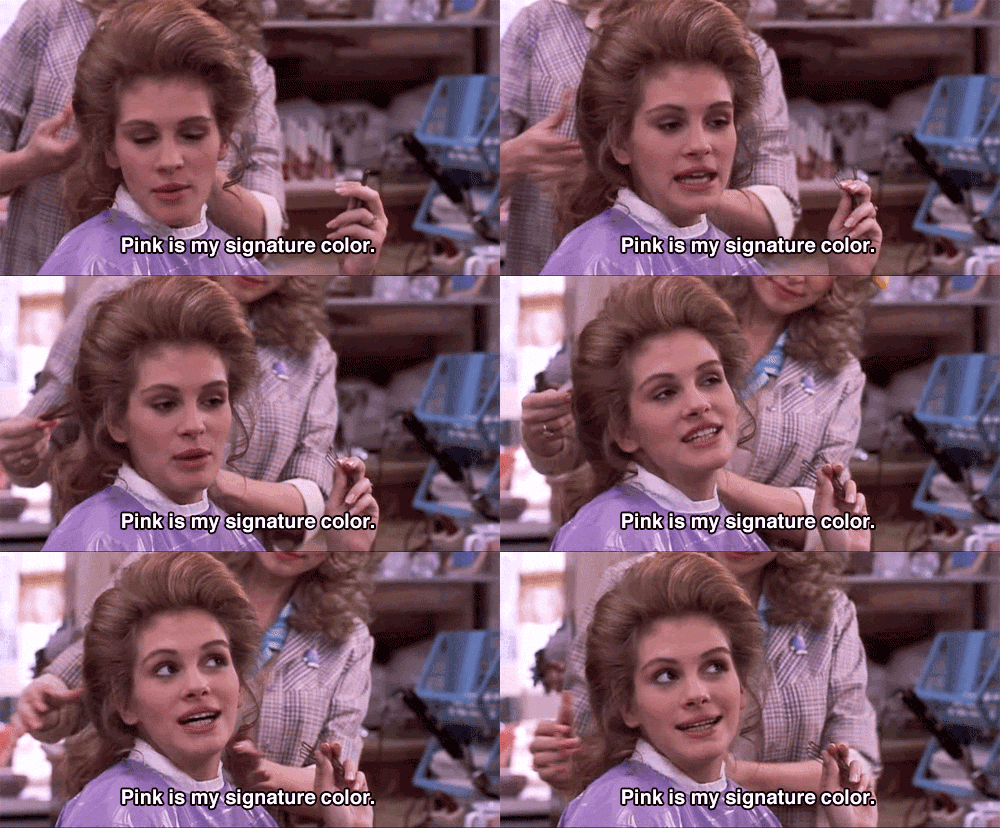
Now, when someone asks me my favourite colour, I’m happy to tell them it’s pink. Except on days when it’s yellow or blue or orange. Pink is lively. It’s fun. It reminds us of sunsets, flamingos and cupcakes. It’s playful but also bold and defiant. It comes from red, after all, the colour of blood, anger, love, power and strawberries. I still don’t like being told what to do, but now I’m doing what I want in a loud and proud shade of pink.

You can't re-fusch-her...


Sunday, 14 February 2016

How it felt to be proposed to

Dramatic re-enactment
Being proposed to is something that girls are supposed to think about. I know this because I have read magazines, watched more than one rom com and went to an all girls’ school. Once, in a year 10 geography lesson, I overheard one girl confidently telling another that she intended her intended to propose to her in a hot air balloon. Never mind that we were about 15 at the time, and as far as I know the proposer in this plan was nowhere on the scene.

I reckon that we first learn this narrative from fairy tales and their Disney rehashes. After a bit of angst you’re going to stumble across the prince, face minor peril along the lines of losing your voice/having a hit put out by your murderous stepmother/being put into coma, or some other routine Jerry Springer-type stuff, and then after a snog or two you get married.

This storyboard is further backed up by a swathe of bossy novels, which spend about 300 pages pretending that the dashing hero is never going to propose to the plucky heroine and then, bam, 83 hours of your life later that is exactly what happens. You nearly had me there Austen, you wily minx. When those have started to seem a bit samey, you move on to glossy rom coms starring beautiful, funny, successful grown women all pining over the question of getting to that moment. Oh do shut up, Bridget.

Obviously, the initial reasoning behind this obsession was based on what for most women in the Western world is now a thankfully defunct social order. Since women can now earn our own money and pay our own bills and live alone, we’re not relying on some guy to come along and provide a way out of the parental home, plus a bit of cash. We get to find other purposes in life, like a high flying career as a trapeze artist or travelling to every abandoned McDonalds in America, or learning how to do the scorpion pose.

And yet society is still so in love with love that there remains to this day sensible adult people who spend time fantasising about their ideal proposal. There are hundreds of thousands of videos on YouTube to give you ideas, like the guy who buttered his girlfriend up with a puppy first (cue hysterical tears) and put the ring around its neck (cue sounds only the puppy could hear). There’s the guy who ropes his family and friends into performing a choreographed parade to Bruno Mars’ Marry You. You will cry. And hate yourself for it. And then, of course, there are the ones that don’t go so well, generally at sports games, but before we start dying inside for these guys, remember that these are probably staged. Or that’s what they’ll claim.

I am not someone who planned out how I wanted a future mystical man to propose. This is partly because, as the child of divorced parents, I didn’t think I would ever be getting married. Maybe some time after 35. And more likely never.

I had fully planned to be an old lady with purple hair, living in a New York apartment crammed with books and mad artefacts from my global travels, eating granola all day and wearing ballgowns and Converse because there was no guy around to be confused about my eclectic fashion sense. And then I went to Berlin and met someone who switched the gear on that grand life plan. Insert long story involving a deployment to Iraq and lots of Skype and over a year waiting to see each other again. I was sitting alone in Phoenix Airport, waiting for my flight back to Heathrow, when I knew that I was going to marry him, in the same unquestioning and total way that I know where the Tube doors will stop and which is the squeaky stair in my childhood home and that it’s always 5 o’clock somewhere.

Four months and a trip to London and a trip to Vegas and more Skype and many discussions later, including a 6am inquiry about what ring I wanted (er, huh?), we’re walking back to my flat after watching Bridge of Spies. Because nothing says romance like Cold War dramas starring Tom Hanks.

It’s a bit damp but mercifully mild, and late enough on a Tuesday night before Christmas that the Southbank has mostly cleared of tourists. I’m full because I've had nearly an entire bag of slightly stale-tasting sweet cinema popcorn and a cheeseburger and chips. My hair is all over the place because of the drizzle. But I don’t really care because he’s actually here, in 3D, and he has warm hands, and I have a sneaky suspicion I know what’s coming.

I’m intuitive, OK.

We get to our favourite bridge, which has a view east of Waterloo Bridge, Southbank, St Paul’s and the Shard in the distance. He pulls me gently over to the silver railings. And he gets out this white box. And time stands still.

Turns out getting proposed to is a lot like deciding to have sex for the first time. Throughout your life you’ve heard that this is a pivotal moment that will mark a dividing line between the time before you knew what all the fuss was about, and the time when you’re in the know. But it’s actually the decision itself that is more important, more formative, than the exact moment.

Standing in front of this man, who is funny and kind and maddening and caring, I decided that despite years of being steadfastly against the idea of committing to one person forever, actually, I’m more than willing to give it everything for him.

And like sex, you’re still the same person after it. That moment doesn’t change you. It’s more that you're knowingly going from one stage of your life to the next. Like levelling up or birthdays in The Sims when they spin round, lights burst out and now they’re a spotty teenager.

Then a drunk guy will come up and congratulate you on being madly in love, and you will smile and nod until he leaves.

I still don’t think everyone should get married, because you know what works for you better than some tax man or priest or nosy relative or diamond salesman. And there's no point planning how to get proposed to, whatever gender you are, because you won't know how it feels until you're there. If the method of question-asking is the most important thing to you, you've kind of missed the long-term implications.

I remember looking across the water as we turned to walk the rest of the way home. The view was the same, we were the same, but while crossing from one end of the bridge to the other, my life had definitely changed in a way I wouldn't have predicted for myself, despite all that Disney. So instead of trying to guess where my steps would fall, I squeezed his warm hand with mine and kept walking.

This old thing?

Monday, 8 February 2016

Long to rain over us: why rain is sometimes pretty wonderful


Rain has a bad reputation. It is the ruiner of barbecues, outdoor weddings and once immaculate hairstyles. Many artists have turned it into a metaphor for horrible, soul-crushing sadness. It's hard to hold a candle in it in cold November. Don't leave cakes out in it. The 15 July, St Swithin's Day, is even dedicated to determining whether we're going to have to put up with 40 more days of it.

But really, everyone, most of the time it's not all that bad. Here's a short tribute to the stuff that got Gene Kelly singin'.

You get to wear wellies
While everyone else is doing the oh-shit-I'm-wearing-Uggs two step around all the puddles, you, the master of the weather, stride confidently through them, feeling like the genius you are. And some even have jelly bean designs.

It is the bringer of rainbows
The symbol of wonderful institutions such as peace and Pride and Skittles only exists because of rain.

It inspires human resourcefulness
Rain is nature's version of a surprise quiz, designed to see who on our streets can handle this bonus obstacle. Faced with a rainstorm, people are forced to get creative. Will you cover up with a free newspaper and be scrubbing ink off your hands for days? Will you sacrifice 5p to rig up a fetching plastic bag head scarf? Or are you going to just make a run for it, as if you can outpace the weather? Total Wipeout for the masses.

We suddenly have something to talk about
'Horrible weather isn't it?' 'Did you hear that storm last night?' 'It's a bit damp outside!' are considered riveting conversational openers in Britain.

Sometimes it understands you
I don't want to walk through brilliant sunshine, surrounded by singing birds and smug daffodils when I'm feeling enraged. I want moody rock video, mascara-smudging, hair-drenching, splashing-off-the-pavement rain. Call it pathetic fallacy if you will, but I'm not ashamed.


You finally get to use the umbrella you've been lugging around
They called you paranoid but who's laughing now? You can get three, maybe three and a half, uses out of this thing before it surrenders to the wind and snaps like an After Eight, so you're not missing an opportunity to get it out. Plus some even have jelly bean designs.

It's sexy
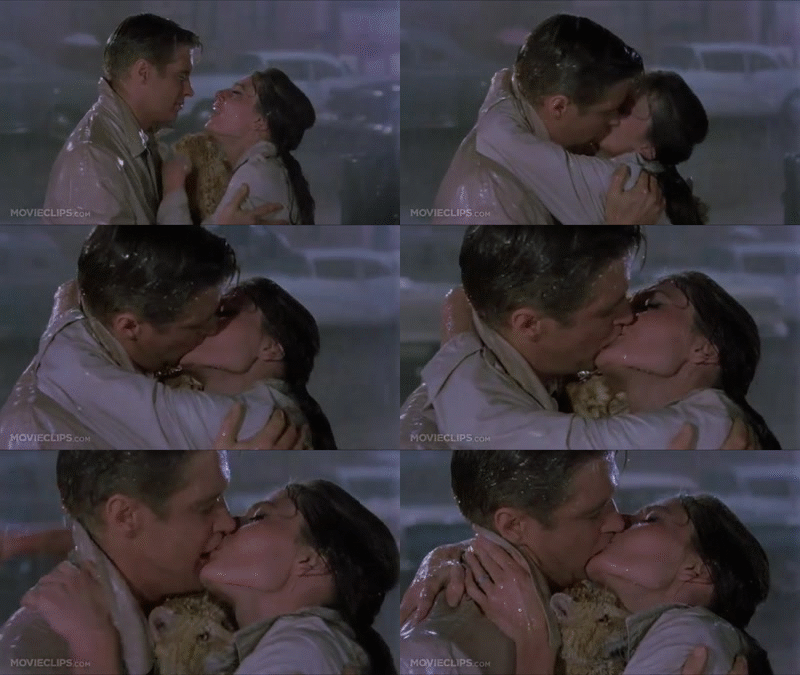
Books and movies and TV shows aren't just using rain to show us that their characters are deeply emotionally perturbed at how things turned out. How many times have writers sat around agonising over the missing quality to make that romantic climax scene really work and suddenly thought, 'I know - we'll add rain!' It makes sense: we know they've got to really want that snog if they're willing to get soaked to the skin for it.

No, it's not The Notebook. Yes, that is a cat.
Pavements look ridiculously good in rain
Not just because it washes the layer of crap off them, either. Street lamps glimmer and gleam like a light show beneath your feet. Here's the photographic version.

It clears the streets quicker than a tiger on the loose
Goodbye, pesky slow-moving tourists and families with five children spread across the pavement. Hello intrepid rain lovers, charging through the water with purpose. Just be sure to dodge the umbrellas.

There's that magical 'smell after the rain'
I vaguely remember the air smelling better after a good old rainstorm, but that was before I moved to London, where it always smells vaguely like the colour grey.

It's better than snow
Take all your issues with rain, freeze them, and let them linger around for a week before turning to brown mush. Feel like hugging a raindrop yet?

It makes being inside that much better
You won't appreciate the sheer joy of being dry and warm and drinking tea until you've got a storm to compare it against.

Sunday, 31 January 2016

How to jaywalk, by an expert

Not how it's done
In 2002, tracksuits with ‘BABE’ on the butt were cool, S Club 7 were still in the charts, and the US Army raised a few eyebrows when they released a first person shooter video game as a recruitment tool.

I was never good at shooter games. I was good at that game Toad. When game consoles were the size of your face and made up of just a few pixels, the aim of this game was to get your ‘toad’ (a square) across the road by moving into spaces before the cars (rectangles) reached you. So instead of becoming a solider, I became a jaywalker.

My personality suits jaywalking – i.e. navigating the road on my terms, rather than being dictated to by crossings and lights. I am very impatient. I don’t like being told what to do. I’m decisive. I walk alone a lot. And I’m often running just behind schedule enough that waiting a whole minute at the side of an empty road will switch me from bang-on-time to actually late.

I’m not here to tell you to start jaywalking: that would be against the blogger’s code of responsibility to readers. It’s not illegal in Britain, but then neither are fireworks or teaching yourself how to do backflips on the home trampoline or piercing your own ears. But like all these things, if you have a sneaking suspicion that you might not be very good at it, you probably shouldn’t try it. And if you are going to do it, do it like a boss.

Family members, fiancé and future medical insurers: stop reading now. For everyone else, here’s how to jaywalk.

Be gazelle
You may be a sloth in your resting life, but when you are crossing the road, you are a gazelle. Think gazelle. Be gazelle.


Gazelles know that crossing a road is not the time to check your phone/stare at the sky/tie your shoelace/read just one more page of your book. Have you ever seen a gazelle pausing to check Google maps while it’s springing across the savanna?

You need to be focussed on moving across that treacherous river without being snapped up by a crocodile. By which I mean getting over the road without being knocked down by a lunatic on a Deliveroo bike. Save the cat video for your lunchbreak, or wait for the green man.

Always check the side roads
Side road traffic is like love and periods and cravings for new potatoes: it appears when you least expect it, with potentially dramatic results. Even if you’ve walked across the same road every day, always check there is nothing coming. One day there will be and it won’t hit you because you remembered this rule, and you will feel a weird sense of pride, relief and invincibility.

Be decisive
You’ve done the necessary calculations and decided you can make it. Go now: another half a second and the car crawling along 10 metres away has found the accelerator and you have to re-evaluate the whole thing.

Never follow a stranger over the road
Like the adult version of stranger danger. Even if they look like they have this jaywalking thing down to an art (and it is an art, darling), don’t follow them. They could be high or unfamiliar with the concept of cars or just an idiot. Plus they’re only looking out for themselves – you follow them two seconds later and the situation has changed. You are the master of your own fate. Yes, you. Not that guy strolling confidently in front of the No. 76 without a care in the world.

Drivers have feelings too
Yes, the rumours are true: drivers are actually human and they need to get somewhere as well. Take advantage of a momentarily clear road and sloooow vehicles, but don’t walk out when they’re accelerating towards a green light and expect them to stop. And save ‘Hey, I’m walking here!’ for moments of justified outrage.

Learn to read traffic
With focus, study and practice you can become a Jedi of the road. Or a Sith, if that’s what you’re into. That driver isn’t indicating, but have all the other cars ahead of them turned towards you? Which way are they spinning the wheel? How long does it take for the lights to go green after the red man has appeared? It becomes a big puzzle you get to piece together.

Crossings are a conspiracy
I’m going to destroy everything you believed about society, the nature of the universe and the order of life. Don’t bother pressing the button at most pedestrian crossings. Like the ‘close doors’ button in lifts, most are put there just to make us feel like we have some control over our lives. Don’t buy into the lie. Truth is beauty. Ugly, sad, twisted beauty. Instead, find the nearest CCTV camera and stare accusingly.

Buses are slow
Although the phrase ‘What happens if you get hit by a bus tomorrow?’ is often used to force people to consider their own mortality, they are far from the being the scariest vehicles on the road. They're like Great White sharks: they're big and tough up close, but this hyperawareness also means you’re more likely to avoid them. Of course you should still look out for them, but it's hard to overlook something bright red that accelerates at the speed of a morbidly obese walrus and stops every 100 metres.

Beware professional drivers
Taxi and van drivers’ livelihoods depend on getting through traffic. They therefore have no tolerance for anyone else being on the road. It can appear that they are playing a game of human bowling, in which you are the pins. Some will accelerate straight at you. They are most likely to beep and shout wildly unimaginative swear words. Treat them with the caution you would grant to a rabid dog on speed who has spotted you wearing Lady Gaga’s meat dress.

Think bike
If you’re crossing between cars stuck bonnet to trunk in a traffic jam, always, always, check that there’s not a Lycra-clad speed demon weaving through the middle or up the side.

Cycling in London is scary, which means that some cyclists see themselves as gladiators pitched against everyone else on the road. They will not deign to inform us which way they plan to veer off to next. Red lights and one way streets and laws about riding on the pavement do not apply to them.

To avoid getting a spoke through your leg, listen out for the sinister sound of spinning wheels and for the bells they're constantly hammering away at, in the manner of a crazed priest announcing a coronation or a wedding. And stay as far away from anyone on a Boris bike as you can without actually leaving the city.

And motorbike
Motorcyclists are more vigilant but also more dangerous if you’re a pedestrian. Not only are many willing to weave into any space they can get into, regardless of who’s currently filling it, but they have the acceleration to change a road crossing situation before you can say Hell’s Angels.

Choose life
The aim of the game is to get across in one piece, which means waiting for the right time, even if that takes swallowing your pride and letting the red traffic light usher you across. You won’t reach your destination feeling like you beat the man and the tourists and the whole damn system, but you will get there, which is more important. Apparently.

Saturday, 23 January 2016

Knowing, loving and losing my grandparents, 14 years apart

Gramps and I, December 2008
Things I remember about my grandma’s death. She died 13 days before my eleventh birthday, in November 2001. She’d started having headaches in about September. I remember because it was around the time of 9/11, and the combination of events made it seem like there was this sombre shadow over the world.

She was in hospital from about October. I remember sitting in the waiting room in Watford General. There was a vending machine that served what I thought was the world’s greatest hot chocolate. It was the kind made with hot water, which formed these little lumps you could scoop out with your finger and bite into to release a burst of sugared chocolate powder. I would take this full-scale stuffed toy dog with me every time we went. It was a Yorkshire terrier (non-dog speakers’ translation: little, long hair, yippy).

I remember the smell. It must have been a certain brand of disinfectant that smelled forcibly clean. It wasn’t overpowering or heavy, but it seeped through the air and into your clothes and into my grandma, pushing out her usual scent of cardigans and walks in fields and cigarettes.

I was only 10 and no one I was so close to had died before. I believed she was going to get better with the same level of helpless faith that I had in God with a capital G and true love and my parents always being right. Every time the adults had one of their conversations in low, worried tones, peppered with medical terms and the phrase ‘brain tumour’, I maintained that simple expectation that she would be fine. Of course she would be fine. I knew they were all worried, but my belief never faltered.

I can tell you the exact place I was sitting when my mum told us that she was going to die. I was in the back right seat of her Ford Mondeo. My sister was in the passenger seat, my brother was next to me. We were going round a bend on the A404, at the point where you can take a right and go to this tiny village that is basically just a pub and some bored sheep. She said, ‘You do know that Grandma isn’t going to get better?’ None of us answered, but it felt like something I’d put high on a shelf fell off and shattered. I could hear Claire sobbing in the front.

So I only had 10 and a bit years with my grandma. I remember her short grey hair and her big round glasses, which she was always pushing up the bridge of her nose. I remember she made really good tents out of bedsheets and read us stories about teddy bears going to a haunted house and let us run through their tiny bungalow and jump on the bed like little maniacs. I remember her long floral skirts. I remember the taste of her ham sandwiches: airy white bread, olive spread, and ham sliced to this certain thickness, all cut into squares. I remember long walks and feeding ducks and the time this swan went for me (they are seriously vicious bastards) and she stepped right between us, put her finger up and said, ‘No.’ You bet that swan backed the hell off.

I sometimes wonder what our relationship would have been like if she’d known me through all my teenage years and as an adult. Those are the tough ones, after all, the ones where your generational differences start to show and you have to find the balance between needing them and loving them all the time, and reminding them that you are your own person, capable of surviving away from them and making your own life decisions.

Life changed for us all after Grandma Diz died. We all called her Dizzy, but her actually rather excellent name was Audrey Beryl May. I learned that the world isn’t fair, in the way that kids only really learn things when bad stuff happens to them. Meanwhile, in grown up world, my dad and aunt had lost their mother and my grandad was coping with losing the love of his life.

I won’t pretend that I remember what my grandparents’ marriage was like, because as I said before, I was under 11 the entire time, and mostly concerned with my Anastasia Barbie and the fate of the Spice Girls. But I remember my grandad on the day of the funeral. He looked lost. Like someone who’d been dropped in a desert and left to navigate his way out alone, with no compass or map to help.

Slowly and with lots of help from my aunt and Dad, he put together a life. At first, he would still pick my sister and I up from school on a Tuesday. I would make us both tea – his very strong, one Sweetex – and we’d have to sit and try to make conversation across this enormous gap of experience and age.

A lot of people, including both my parents, several employers and café customers, have bemoaned my tea-making skills. But never Gramps.

So I went through my awkward teenage years with my quiet, withdrawn grandad instead of my lively, fun-loving grandma. He wasn’t a great conversationalist, especially not with a 13 year old girl. I would avoid talking about her for fear of upsetting him. These conversations were tricky, but I did learn about his life.

He was in the army doing national service, and was stationed in Italy at one point. He was a crack shot and won a medal in a shooting competition, but he couldn’t afford to keep it up after leaving. He worked in a metal workshop – he was very good at shaping it into whatever he wanted. He needed a constant supply of Wine Gums. He was the kind of loyal Arsenal fan who wouldn’t shout at the TV but just stick out the rough and smooth with determined faith. When he was younger he enjoyed playing football, and he was still into golf and snooker, but those things gradually left him when the call of the armchair in the bungalow he had shared with Grandma became more appealing than a bustling snooker hall.

What was most welcoming was that Gramps was not one of those people fiercely clinging on to outdated values purely because they can’t accept the world has changed. He lived in a sort of bubble, with two TVs and the curtains drawn. He wasn’t interested enough in the world to judge people beyond whether they were hurting others or not. I never heard him say anything racist or homophobic. His motto was ‘Each to their own’, even if he couldn’t quite make sense of the ins and outs of things.

Yes, he could be difficult, and his waning interest in leaving the house and life beyond knowing the lottery numbers, Arsenal score and that we were all OK was frustrating, especially for people who did a lot for him with very little thanks. He was stubborn and tactless, often telling me that he didn’t have much to say and he did nothing all day. Not the greatest conversation starters. But that makes it all the more touching that he did push aside the fog of gloom that descended when Grandma died in order to call us just to say hello.

He’d had headaches and neck pains and emphysema for many years, which made breathing and moving difficult. He still got washed and dressed every day, even if it was just to lie on his bed. His hearing was good enough to listen to a conversation, and it was only in the last few months over Christmas that he became forgetful and confused to a worrying degree. I got to tell him that I’m getting married, which he was delighted about. In January we found out that he had an infection in his pacemaker, which could possibly be treated but would result in reduced mobility. Ultimately, it was the combination of this and an intense hip operation that finally wore him down, and he died at around 8pm on 20 January.

I had an idyllic child’s relationship with Grandma Diz that never had to overcome divided opinions or tension or the strain of miscommunication. And I also feel privileged to have got to know my grandad’s white haired self, as well as a snapshot of him in his prime, over the years when our age gaps made communicating that much harder. He might not have been perfect, but he was him, and that was enough. And I will miss him for being perfectly, imperfectly himself.