Showing posts with label sexism. Show all posts

Sunday, 24 April 2016

The dos and don't of chatting up people in public


One of the first things you learn at school, apart from the obvious stuff like how to spell your name and what Biff and Chip did at the zoo, is that strangers are dangerous and you should never talk to them.

While apparently sensible advice, this becomes a bit tricky when you’re also meeting a whole bunch of new tiny human beings and trying to strike up conversations over the sandpit. It makes even less sense as you get older and start noticing people across Year 8 discos and pubs and student unions with whom you’d like to do more than just discuss Pokemon and Dexter’s Lab.

The fact is that, sometimes strangers are just friends you haven’t met yet. All your friends were strangers at one point, even the ones it feels like you’ve known forever. Call me Pollyanna but I don’t think we benefit from a world in which we view everyone we don’t know with suspicion.

However, there are ways to go about approaching strangers that are better than others. I get stopped in the street by men quite a lot. This is quite a difficult problem to talk about, because people assume I’m bragging. ‘Oh God, some stranger asked me out again when I was just trying to walk home. Also my bank account is too full, my house is too big, and I’ve been asked to go and address the UN but it’s the same day I’m accepting my Oscar. Why is life soooooooo hard?’


I’ve stopped wondering why this happens and what it says about me. Probably it’s because I’m a young woman who walks around London by myself, and I’m a fairly solid middle range on the attractiveness scale that runs from Quasimodo to Cindy Crawford. I do hope I don’t just have some sign or weird pheromone only men can sense that says, ‘Talk to me, I will definitely have sex with you’.

Being hit on by a random person in the street is not always a problem (at least not when you’re single!) Like I said, not all strangers who approach you are crazy, creepy or trying to sign you up to a cult. Done politely and respectfully, it’s quite flattering. Who doesn’t want to be told that of all the people in the crowd, someone noticed you and was fascinated enough to come up and say hi?

However, done badly and it leaves you feeling pissed off and violated. It feels less like that scene in Les Mis The Movie where Eddie Redmayne spots Amanda Siegfried across the street and is like, ‘MAN ALIVE, I would totally give up my French revolutionising for that babe,’ and more like being the gazelle the lioness has got her eye on in a David Attenborough documentary.

The difference between the two is that the second is not a conversation, it’s a power play. They have an objective (your number, a date, sex, whatever) and the entire point of stopping you is not to open up the possibility of getting it, but to achieve that mission by any means necessary.

These interactions always start the same way. I’m walking down the street in my own headspace, trying to remember the words to Moves Like Jagger or if I bought yogurt the other day, when suddenly example guy runs up and says a variation on the following: ‘Hi, excuse me, I just saw you walking and I had to tell you that I thought you were really beautiful/I really like your eyes/I love your shoes/you look like you want to party.’

Look, I know, I know, ‘Oh poor you.’ Do I think I’m beautiful, have nice eyes or amazing taste in shoes? Well, yes to the third (Converses ftw) but the others, fuck, I don’t have time to worry about it. I’m just reporting the facts here, and these are the lines I get.

So OK, I’m only human, and actually the first few times this happened I was like, ‘Well isn’t that nice?’ Except for the, ‘You look like you like to party.’ Er, I’m carrying a Sainsbury’s bag full of groceries, wearing a huge parka and trying to storm down The Strand. What kind of parties are you going to?

This insincerity is your first sign that they are ticking off The Checklist.

I’m starting to suspect that there is a forum somewhere in the depths of the internet that tells men how to hit on women in the street, and post four is The Checklist. I’m all about helping people overcome shyness to approach others, but this reeks of a predator desperately picking out someone – anyone – so they can go through the motions, get it over with, and maybe get laid.

It goes something like:

  • Approach with compliment. It’s OK, you don’t have to mean it. Look at what she’s wearing and go for that.
  • Now you have her attention, make sure you get her to stop. You can block her path or touch her. You can even outright demand it. Just make her stop. 
  • Now she has to talk to you to be polite, so ask her a question. Try, ‘Where are you from?’ If she asks you to guess, say somewhere sexy, even if it’s blatantly obvious she’s not Italian or Spanish or French. Comment on her clothes. Ask her where they’re from, say you like bright colours/trainers/novelty sunglasses. Again, this doesn't have to be true. Just make sure she can't leave without feeling like a rude person crushing some poor guy's brave soul. 
  • Make it clear that you have somewhere to be right now but you are interested in meeting later. 
  • If she says she’s not interested, just keep asking her questions. This will prolong the conversation enough to make her desperate to get away from you. 
  • Now, ask for her number. If she says no, ask again. She will give in eventually.
  • Only back off if she says she has a boyfriend/girlfriend/fiance(e).
  • Walk off with her number. Wait five minutes, repeat.

The major difference between the ones you want to date and the ones you want to slap is that refusal to accept no for an answer. I know when you’re not really into the conversation, you’re just ticking off this list because you’re not listening to me.

One of the most frustrating things is that still, in 2016, the quickest way to get a guy to back off is to tell him you have a significant other. To be fair, no one wants to be the person trying to break up a relationship, but often it feels like the reason for this is that you’re showing them a ‘PROPERTY OF’ stamp. It makes you feel like you need to have someone else vouch for you (and they’re probably assuming it’s another guy) for your refusal to count.

One guy told me, ‘I wish you’d mentioned you had a boyfriend earlier, I wouldn’t have talked to you for so long.’ Because apparently I’m only worth talking to if you think there’s some slim chance you’ll get laid. Another wasn’t even put off when I mentioned I had a boyfriend, until I added that ‘He’s in the US Army’. My relationship status – and my now-fiance’s job title and particular set of skills – have nothing to do with whether or not I give you my time.

So given my cynicism, am I saying you should never try talking to someone you fancy in the street? No! I’ve never used Tinder but I think a face-to-face meeting with someone is a much better way of vetting the weirdos and just-completely-incompatibles than looking at a picture on a screen.

So, here are my top tips for chatting up people in the street.

Don’t approach people who are busy
If I am storming through Leicester Square with a suitcase or I’m on my lunchbreak or trying to get on a bus (yes, that happened) I probably don’t want to talk to you right now.

Be honest
If you’re serious about taking this meeting further, don’t big up your job or lie about what you’re doing later. I might not be able to tell now, but this isn’t the best way to start any kind of relationship (casual or whatever).

Don’t touch me
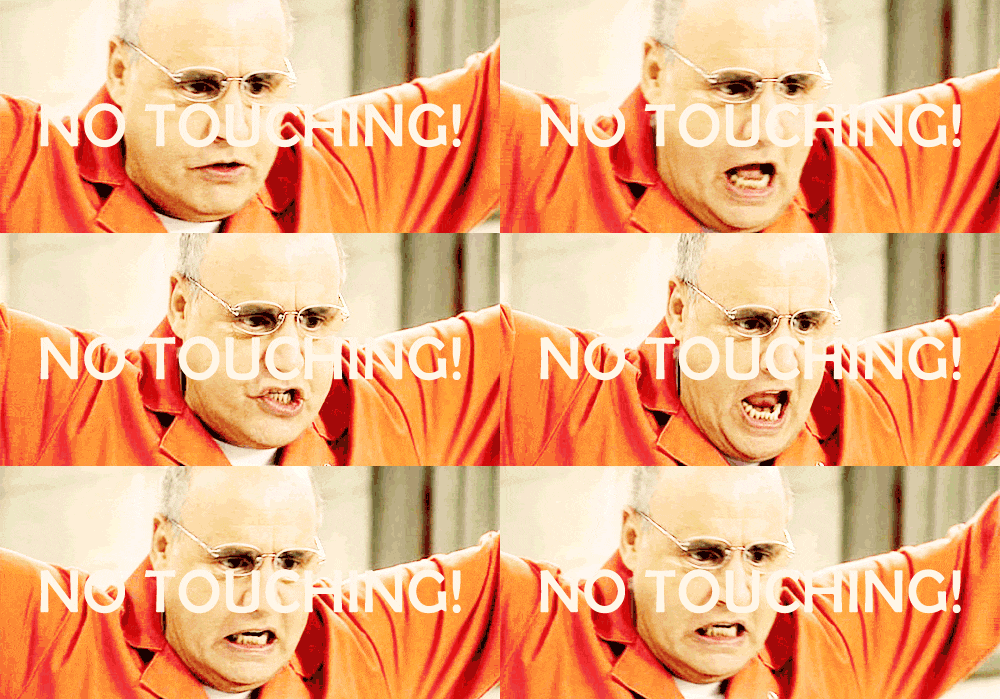
Seriously, you’ve already broken social norms by trying to talk to me, so show that you’re doing this the polite, non-forced way and keep your hands to yourself.

Be open to rejection
I will try to be polite – I’m not out to hurt people and I know it takes effort to approach someone. But I don’t have to give you my time, so don’t be a jerk if I don’t want to talk.

Use your common sense
Everyone has awkward moments but come on, guys. One time I was reading Maya Angelou when a guy came up, said ‘Hi, excuse me, etc’ then asked me what I was holding. I said, a book. His awed response: ‘Wow, for real? I’ve only read Harry Potter.’ Another guy merrily informed me that he was, ‘So high right now.’ In the street at 7pm. Good luck with those life choices, excuse me while I’m heading in the opposite direction.


Talk to me like a human
I once got some insight into pick-up artists from a guy who tried it on in the National Portrait Gallery. I turned him down and called him out on his bullshit. Turns out he was actually doing some class about how to talk to women (nauseating, I know). His view was that we are manipulative monsters out to make men jump through hoops before we consent to sex in order to make them pay for things. Yep. I pointed out that we are actually just people. He didn’t get it. The fact is, I am just a human so talk to me like you actually want to know about me.

Don’t pressure yourself into getting everyone’s number
If we talk and you realise we’re not compatible, you don’t have to get my number: that would count as forcing it. That’s the point of talking! Don’t put that pressure on yourself to follow through with everyone you hit on. You are not somehow less manly because you don’t actually want to sleep with everyone.

Probably some people will still be thinking this whole thing is some weird brag, and I can’t stop that. It’s actually just something that has been part of my life since I moved to London a couple of years ago. I’ve told my fiance about it, even though I imagine sometimes he would probably just rather not know. He’s not happy, just as I would not be super amused to find out that he’s got women throwing themselves at him (Alexa, I’m looking at you) but I know he trusts me. And I’m curious to hear from other people – whatever gender – to find out your take from either side. Does this happen to you? Have you asked someone out in the street? How did it go?

So go ahead and ignore your parents and teachers and talk to strangers. Just do it nicely.

Saturday, 27 February 2016

A personal and Western history of the colour pink


My relationship with the colour pink is surprisingly complicated. During my ballerinas-Barbies-and-princesses phase, it was the default answer to ‘What colour do you want this in?’ – whether that referred to clothes, plastic jewellery or heavily dyed food products. But when I hit about 13, I started to rethink this apparently easy loyalty.

At that age, when you’re just starting to look at the world around you and decide who you want to be, I realised I didn’t really like the stereotypical feminine identity society was holding out, like a frilly straight jacket.

At this point, third wave feminism was a ripple somewhere in the ocean. It's after Girl Power, Riot Grrl and Buffy, but before ‘This Girl Can’, Everyday Sexism and Leslie Knope. Being ‘girly’ meant being silly, bitchy to your friends but also totally reliant on them, obsessed with boys and shoes, unable to look after yourself or go anywhere alone. I could be cattier than Garfield and was pretty confident I was going to marry Leonardo DiCaprio, but I was not very good at the other things on this list.

After a few lacklustre attempts to get better, I found I didn’t want to be. I don’t like being told what to do, so I hit back against things I felt were tying me to this expectation, like bras, dresses, fancy shoes – and, of course, pink.

Turns out I was not so much ahead of my time as behind it. Pink has not been a ‘girl’ colour for very long. This is one of those myths we all know, like people thinking the world was flat and Marie Antoinette suggesting that peasants eat cake.


Before the 19th century, people in Western society assumed that we were all born knowing our gender identity innately, therefore they weren’t so much worried about confusing babies by putting them in the ‘wrong’ colour, but about making sure they looked different from adults. Boys and girls wore pastel coloured dresses decked out with frills and lace, and cherubic golden curls were encouraged on every child.

In 1927, Time magazine prodded a bunch of experts at department stores to come down on one side or the other. They weren’t just selected for their grip on psychological trickery, but because prescribing colours to each gender would mean that parents who had a daughter then a son would have to buy a whole new collection of clothes instead of letting him run around in pink Hello Kitty skirts. Or whatever the kids were wearing then. All of them tried to assign girls the daintier, more delicate hue, but there was an equal split between whether this should be blue or pink.

This blissful confusion ended not with a bang but a wave of new thought that gradually grew and crashed in on society in about the 1940s. Psychologists in the 1890s had started to introduce the idea of nature vs nurture when it came to genders, suggesting that parents who didn’t want their little boys to grow up ‘soft’ while their daughters climbed trees and scared off potential husbands by arm wrestling them to the floor should think carefully about what their little darlings were dressing in. This was also a post-Oscar Wilde trial world, when people thought that homosexuality was caused by confused gender identity – that gay men were actually women – rather than an innate part of a person’s personhood.

So on the one hand, pink is just a colour, but thanks to human meddling, it’s also not. Associating yourself with pink still signifies that you’re ready to embrace feminine qualities. For example, when a company producing ‘manly’ things like power tools or computer equipment or pens (thanks Bic) wants to show us lady folk that they have taken our extensive needs into consideration, the first thing they tend to do it dye the stuff pink.

Fake ad: real product

Far from coming across as an excellent colour choice, this just seems patronising. By all means make pink hammers, but don’t pitch them to me as your women’s range. If the only thing you’ve changed is the colour, you have to wonder why they haven’t been marketed to us before. And if you’ve changed more than the colour, you might want to let me know useful modifications instead of chirping on about how good it will look in my handbag. I’ll do the accessorising, love.

However, patronising marketing campaigns aside, the future of pink is looking brighter. It’s been reclaimed and transformed into a colour of resistance – and not just for feminists. Alongside the rainbow, it’s the colour you'll see most of at gay pride. This is not because 'all gay men love pink, right?' but as a punch in the face to the pink triangle, which was the symbol forced on gay men sent to Nazi concentration camps for their sexuality. (The same symbol was also used to identify rapists and paedophiles, so you can see exactly how they were viewed.)

Where once associating homosexuality with pink was intended to shame gay men as both sexually deviant and separate from typically masculine characteristics, it's no longer a symbol of submission but a bold show of defiance – a celebration of an identity that some people may not understand but which isn’t going anywhere.

In a very different display of resistance, it’s also the colour of Breast Cancer Care. Since breast cancer affects mostly women, the charity has adopted the colour that we understand as representing this gender to show that for all the things that might separate those who get this disease, they have a sisterhood to draw on and teams of volunteers and scientists united under this colourful banner.

Once you’ve distanced yourself from an identity the world would force upon you, and realised that humans have the chance to be more complicated than that, you have space and time to start bringing back individual bits that you quite liked. You get to open up the box and discard the ideas, traits and symbols you don’t like and keep the stuff you do. Now that we’re swimming in the waters of third wave feminism, to use yet another ocean metaphor, our understanding of what is feminine has expanded. It can mean capable, independent, intelligent, resilient, thoughtful, organised and creative.

Rediscovering pink as an adult with a better sense of your own identity is like going through your wardrobe and finding a jumper you loved two winters ago but totally forgot about when the weather warmed up. It fits me even better now because I have more ways to wear it.

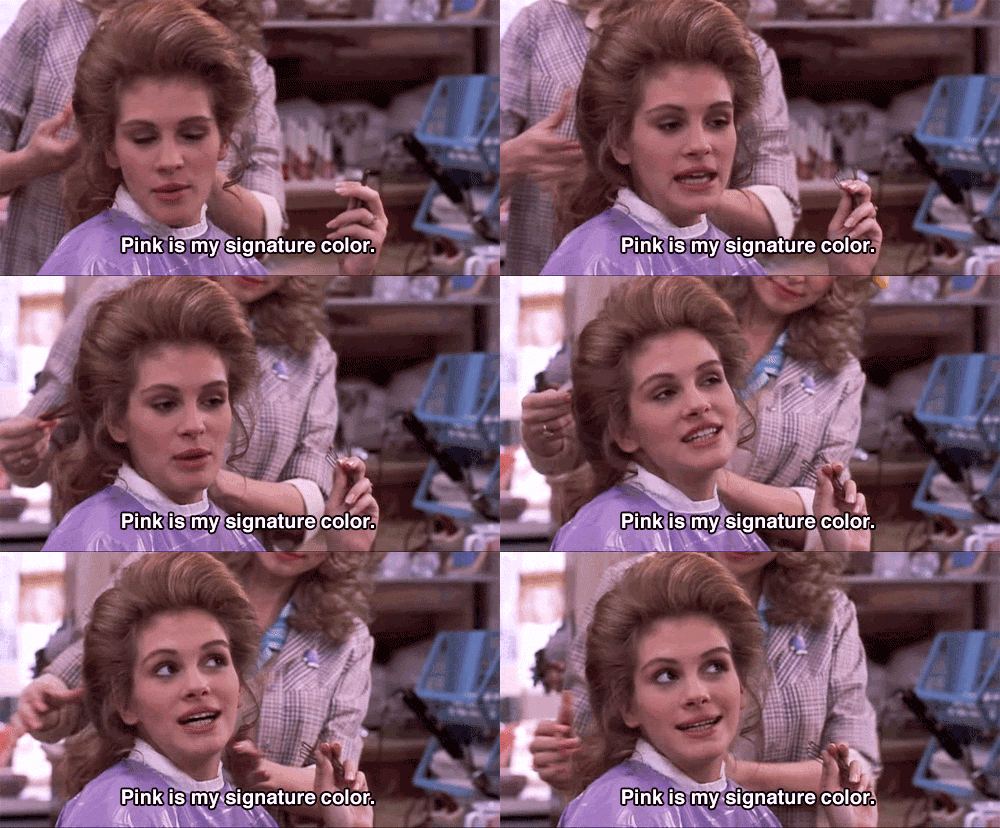
Now, when someone asks me my favourite colour, I’m happy to tell them it’s pink. Except on days when it’s yellow or blue or orange. Pink is lively. It’s fun. It reminds us of sunsets, flamingos and cupcakes. It’s playful but also bold and defiant. It comes from red, after all, the colour of blood, anger, love, power and strawberries. I still don’t like being told what to do, but now I’m doing what I want in a loud and proud shade of pink.

You can't re-fusch-her...


Wednesday, 19 December 2012

Death of the Lady: why 'ladylike' is a sexist term

'If we bury the turkey in sprouts, no will notice the burnt bits.'

Bent over a saucepan of Brussels sprouts on BBC Breakfast this morning, Gordon Ramsay raised the problem that plagues many of us this year: “They will make you fart,” he warned. His interviewer, presenter Susanna Reid, immediately brought him up on this, quickly claiming in outraged tones that women don’t fart, sweat, burp or swear. I hate to break it to you Susanna, but if this true, you should really seek medical advice. For the rest of the unenlightened out there, women do, indeed, fart, sweat, burp, swear, urinate and defecate. Sometimes, I expect, all at once. Unfortunately, Susanna is not alone in her attempt to deny us these basic bodily functions; I have heard several friends protest in horror that they would never dream of performing any of these acts.

This is pathetic, ridiculous and maddening. By placing women on a fart-free pedestal, we are chaining ourselves to an archaic presentation of women as perfect porcelain dolls, whose only purpose in life is to be pretty decorations that are seen and not heard. Or smelled. The unenlightened should prepare themselves for a bold claim: to perpetuate this view is to present ourselves as inhuman. Yes, that’s right. Before you roll your eyes and return to polishing your club, let’s remind ourselves that this claim denies women the basic functions of human anatomy. For anyone who thinks that no one could be quite so stupid as to really believe this, I would refer them to a particularly ignorant ex-housemate, who had such trouble coming to terms with this notion that he chose to ignore clear evidence and to simply deny it. Mind you, he also believed that all women began menstruation on the first day of every month.

Clearly, gentlemen, it’s not just what we say that some of you struggle to comprehend; many of you have a lot to learn when it comes to female anatomy. Think about it, boys: if women are physically incapable of defecation (translation: pooing, shitting, taking a dump), why are we so frequently the subjects of adverts for diarrhoea medication?

Of course, all this reverts back to the notion of what is and is not considered ladylike. Traits in that first category include lipstick, needlework and child-bearing, while tattoos, swearing and an avid dislike of children would probably fall into the latter. To label the term ‘ladylike’ as restrictive is not to say that any of the activities which are given this description are innately wrong. It is more important to focus on what this term intends to prevent us from doing.

To draw on the example of the Olympics, sports such as boxing, judo and football are still held as pursuits more suited to men. To follow national television coverage would be to believe that no woman has ever so much as looked at a football, let alone competed in an international tournament. Boxing coach Hal Adonis (surely an ironic surname if ever there was one) commented that female boxers who haven’t been hit by their parents ‘don’t belong in boxing’, since women apparently need some form of motivation other than sporting prowess to get our pretty little heads angry enough to want to fight. On watching Gemma Gibbons win her Judo silver medal in London 2012, Andrew M Brown wrote that he 'couldn't help wondering about their soft limbs battered black and blue with bruises,' not something he apparently concerns himself with when it comes to competitions between men.

These examples demonstrate that many still distinguish between activities which are acceptable for men and women based on the archaic notion that women are inherently flimsy, fragile creatures. Like it or not, the word ‘ladylike’ is a sexist term because it allows people to restrict what women do purely because of the fact we have vaginas instead of penises. Of course, this type of gender-based classifications affects men too; how many have ever felt pressured to take up one sport over another ‘feminine’ one or to use terms which intentionally subjugate women in order to appear manly?

No one wants to be surrounded by a farting family post-Christmas dinner. But ladies, if you do let out a belter, don’t blame the man sat next to you: you’re only human, embrace it.